
Short answer: A non-contact thermometer suits workshop jobs that need quick, repeatable surface-temperature comparisons without attaching a probe. It is most useful when the target is visible, larger than the measurement spot and made from a surface whose emissivity is understood. It is not a medical thermometer, thermal camera or stand-alone fault detector, and it does not reveal the temperature inside a machine or enclosure. The Thermometermax offer is labelled as a Fluke 62 MAX. Official Fluke material specifies 10:1 optics, adjustable emissivity and IP54 protection; the retailer's conflicting IP40 wording should be resolved before the product enters a workshop procedure.
Choose workshop tasks that fit surface-only measurement
Good candidates are accessible surfaces that can be named and revisited, such as a painted housing, guarded machine exterior, pipe covering or bench component after it has been made safe to inspect. The useful output is a documented surface value or comparison, not an explanation of the machinery's internal condition.
Do not use the product for people, clinical decisions or food-safety compliance unless the exact device and procedure are expressly approved for that purpose. The available retailer and Fluke documents describe an industrial surface thermometer, not a medical or food probe.
| Workshop task | Fit for an IR spot thermometer | Boundary |
|---|---|---|
| Compare the same painted housing point over time | Potentially suitable | Keep operating context and geometry consistent |
| Measure inside a closed bearing or gearbox | Not suitable | The instrument reads the visible surface |
| Check polished metal directly | High uncertainty | Reflectivity and emissivity require an approved method |
| Assess a person's temperature | Not supported | This product is documented for industrial surfaces |
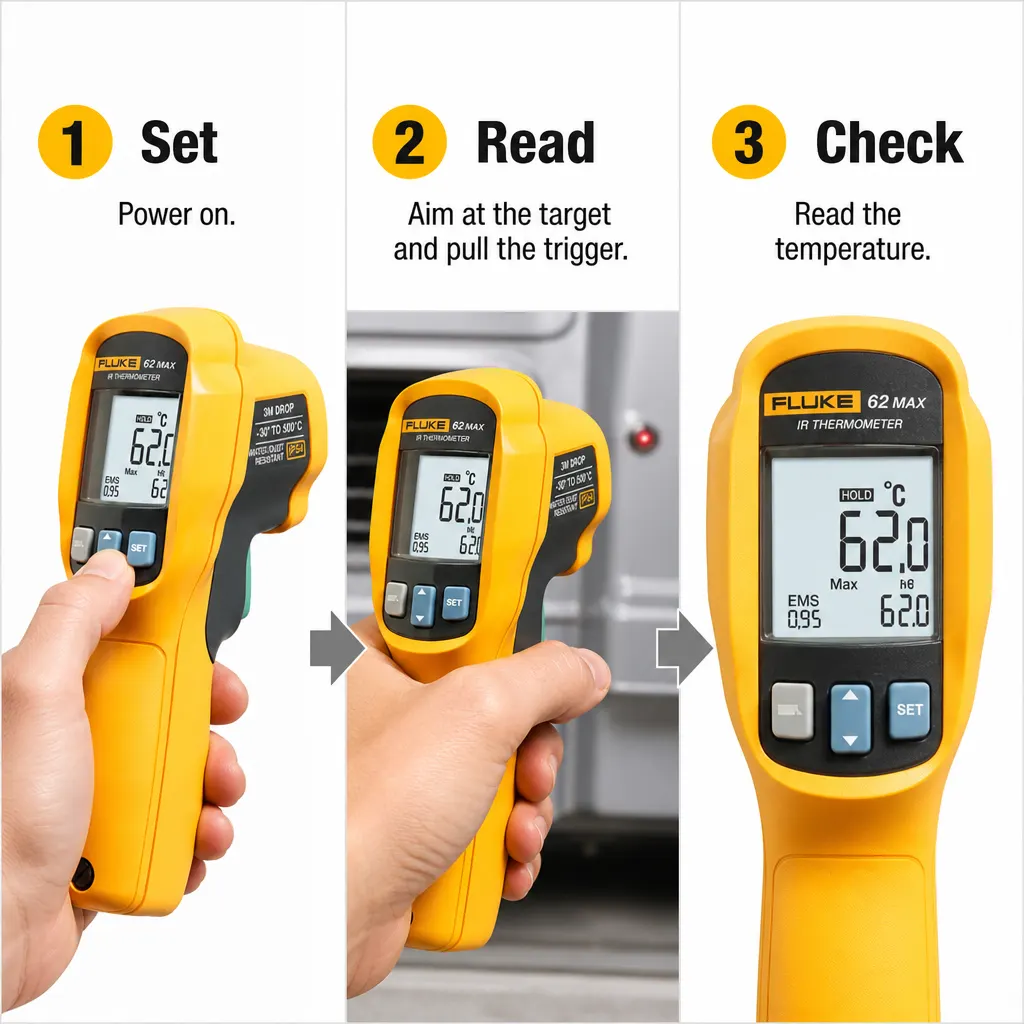
Create a repeatable workshop reading record
A repeatable record identifies exactly what was measured and under what conditions. Avoid collecting unlabelled numbers. Differences in distance, surface finish, operating load, airflow or warm-up state can produce a change that has little to do with deterioration.
Keep the thermometer within its documented role. An unexpected result should trigger the workshop's established review process, which may call for a competent person or another approved instrument. It should not prompt removal of a guard, opening of an electrical enclosure or continued operation against site rules.
- Name the target and confirm that it is externally accessible under the workshop's safe procedure.
- Record the material or coating, normal operating context and the reason for taking the reading.
- Check the exact instrument manual, battery indication, lens condition and relevant settings.
- Use a documented distance that keeps the complete measurement spot within the target.
- Log the displayed value with distance and emissivity setting, then escalate anomalies without diagnosing their cause.
Understand emissivity, reflections and target size
Fluke lists emissivity adjustment from 0.10 to 1.00 for the standard 62 MAX and warns that reflective objects can read below their actual temperature. A single setting is not automatically correct for every workshop material. Painted steel, oxidised metal, plastic and polished metal should not be compared without accounting for their different surfaces.
The 62 MAX is listed as 10:1, calculated at 90% energy. A larger distance therefore produces a larger spot, and surrounding bench, guard or insulation may influence the result if the target is too small. The manual shows 38 mm at 300 mm, 60 mm at 600 mm and 100 mm at 900 mm. The laser shows where the instrument is aimed, not the entire measured circle.
| Variable | Why it matters | What to record |
|---|---|---|
| Surface finish | Changes emitted and reflected infrared energy | Material, coating and condition |
| Distance | Controls nominal spot size | Distance from lens to target |
| Target width | Must contain the complete spot | Usable surface area |
| Emissivity setting | Affects displayed temperature | Setting and source used to select it |
| Operating context | Affects comparison over time | Load, run time and surrounding conditions |
Check the official 62 MAX data before ordering
The retailer identifies a Fluke 62 MAX with non-contact surface readings, AA power and a compact pistol grip. Fluke's official material specifies a -30 °C to 500 °C range, a 10:1 optical ratio, emissivity from 0.10 to 1.00, IP54 protection and one AA battery. Under the stated calibration geometry with ambient temperature at 23 °C ±2 °C, accuracy at or above 0 °C is ±1.5 °C or ±1.5% of reading, whichever is greater; wider limits apply below 0 °C.
The retailer's IP40 wording conflicts with the official IP54 specification and should be resolved, not selected as a conservative product rating. Also confirm whether the workshop needs a traceable calibration certificate, logging or imaging: Fluke says the 62 MAX does not come with a calibration certificate, and the official data sheet assigns internal logging to the 64 MAX rather than the 62 MAX.
- Confirm that the delivered model label says 62 MAX, not 62 MAX+.
- Use the official 62 MAX manual for range, accuracy, optical ratio and emissivity.
- Ask the retailer to resolve its IP40 wording before ordering.
- Arrange calibration evidence separately if the workshop requires traceability.
- Choose another instrument if the procedure requires thermal images, contact readings or traceable calibration evidence.
Related guides and product details
The offer is a reasonable candidate only for documented surface checks; confirm the 62 MAX model and require the retailer to resolve its IP-rating discrepancy before adding it to a formal workshop process. Read Infrared Thermometer for Electricians: UK Buying Guide for related guidance. Read IR Temperature Gun for HVAC: What to Check Before Buying for related guidance. Review the documented specification on the Fluke 62 MAX handheld infrared thermometer product page before ordering.
Sources and safety context
- Supports the retailer's 62 MAX offer identity, AA power, pistol-grip format and surface-reading purpose; its IP40 wording conflicts with Fluke. Fluke 62 MAX handheld infrared thermometer details.
- Supports the standard model's 10:1 ratio, emissivity range, AA power and IP54 statement. Mini Infrared Thermometer | Fluke 62 MAX IR Thermometer.
- Supports surface-temperature scope, reflective-object warning, laser precautions and instrument checks. 62 MAX/62 MAX+ Infrared Thermometer Users Manual.
- Supports repeatable target-size, line-of-sight, emissivity and environmental guidance. How to Get Great Results with an Infrared Thermometer.
- Supports the planning and competence boundary where workshop checks involve electrical equipment. Work on electrical equipment, machinery or installations.