
Short answer: An infrared thermometer can help a UK electrician compare accessible surface temperatures without attaching a contact probe, but it cannot establish why a component is warm or make work near electrical equipment safe. Fluke's official 62 MAX documentation specifies a 10:1 distance-to-spot ratio, adjustable emissivity and IP54 protection. The retailer identifies the offer as a 62 MAX but lists IP40, which conflicts with Fluke's specification, so ask the seller to resolve that discrepancy before purchase. Any use around electrical equipment must remain within the employer's risk assessment, safe system of work and the limits of a competent person's authorised role.
What an infrared thermometer adds to an electrical inspection
The useful role is comparison. A point-reading thermometer can record the temperature of an externally accessible surface at a named location and support a repeatable maintenance record. It does not see through a cover, measure current, test insulation or identify a loose connection. A high or changing value is a reason to follow the organisation's escalation procedure, not a diagnosis.
Define the question before choosing the tool. If the job requires a thermal image, contact measurement, traceable calibration evidence or a specified uncertainty, a simple infrared spot thermometer may not provide the required record. Fluke's product information says the 62 MAX is not supplied with a calibration certificate, so any traceability requirement must be arranged separately.
| Inspection question | What a surface reading can show | What it cannot establish |
|---|---|---|
| Is this accessible point warmer than the same point recorded earlier? | A temperature comparison when location and conditions are kept consistent | The electrical reason for any difference |
| Do comparable external surfaces differ? | A difference between defined measurement locations | Whether either item is defective |
| Is an internal component overheating? | Nothing conclusive through an enclosure | The temperature or condition of a concealed component |
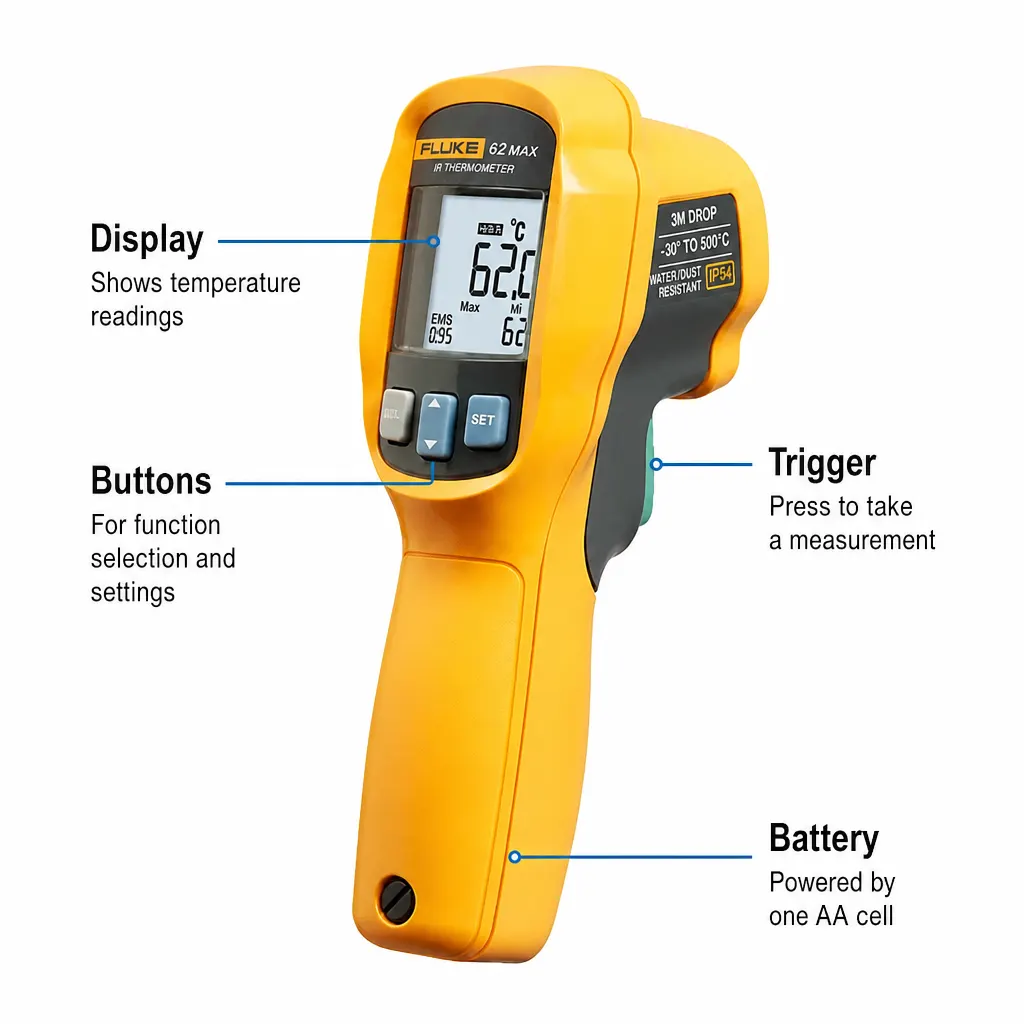
Use the official 62 MAX specification
The retailer identifies the product as a Fluke 62 MAX. Fluke's official page, user manual and data sheet agree that this model has a -30 °C to 500 °C range, a 10:1 optical ratio, emissivity adjustment from 0.10 to 1.00, IP54 protection and one AA battery. Under the stated calibration geometry with ambient temperature at 23 °C ±2 °C, accuracy at or above 0 °C is ±1.5 °C or ±1.5% of reading, whichever is greater; the manual gives wider limits below 0 °C.
The retailer's IP40 wording conflicts with all three official Fluke sources. Do not select IP40 as the safer assumption or invent a separate promotional specification. Ask the seller to resolve the discrepancy and confirm that the delivered model is the 62 MAX, not the 62 MAX+, before relying on the official 62 MAX data.
| Detail | Official Fluke 62 MAX specification | Retailer listing | Buying decision |
|---|---|---|---|
| Model wording | 62 MAX | Promotional 62 MAX; not 62 MAX+ | Confirm the delivered label says 62 MAX |
| Ingress protection | IP54 | IP40 | Require the retailer to resolve the conflict |
| Distance-to-spot ratio | 10:1 | Not stated | Use the 62 MAX manual only for a confirmed 62 MAX |
| Emissivity | 0.10 to 1.00 | Not stated | Follow the official model manual |
| Range and accuracy | -30 °C to 500 °C; at or above 0 °C, ±1.5 °C or ±1.5% of reading, whichever is greater | Not stated | Read the full below-zero accuracy conditions before use |
Keep electrical safety outside the thermometer choice
This guide does not provide a live-panel procedure. HSE says electrical work must be planned and carried out by people competent for the task, with secure isolation where work is undertaken. HSG85 says work on or near exposed live conductors should rarely be permitted and that dead working is essential unless all three legal conditions for live work are met.
The employer's task-specific risk assessment and safe system of work decide whether an external observation is permitted. A thermometer's non-contact design does not authorise removing a cover, defeating an interlock, entering a restricted area or approaching exposed live conductors.
- Do not use this article as authority to inspect energised equipment.
- Do not remove covers, open beyond the approved procedure or approach exposed live parts for a reading.
- Do not treat a surface temperature as proof of electrical safety or a fault.
- Refer unexpected observations to the responsible competent person.
Emissivity, spot size and interpretation limits
Infrared thermometers respond to energy radiated from a surface. Fluke warns that reflective objects can read lower than their actual temperature, so polished metal and mixed finishes can undermine a comparison. An emissivity setting is useful only when the operator understands the surface and follows the manual for the exact instrument.
Distance changes the measured area. Fluke specifies a 10:1 optical ratio for the 62 MAX, calculated at 90% energy, and the manual's spot diagram shows 38 mm at 300 mm, 60 mm at 600 mm and 100 mm at 900 mm. The laser indicates aim, not the full spot. Keep the complete measured area within the intended target and use the official diagram rather than a simple close-range division.
- Do not compare shiny bare metal directly with painted or insulated surfaces as though emissivity were identical.
- Do not assume the laser dot is the complete measurement area.
- Do not use a spot reading to clear equipment for service or to identify a fault.
- Do not substitute 62 MAX+ specifications for a product labelled 62 MAX.
Related guides and product details
Buy only after the seller resolves the IP-rating discrepancy and your employer's electrical procedure calls for non-contact surface comparison rather than diagnosis or thermal imaging. Read IR Temperature Gun for HVAC: What to Check Before Buying for related guidance. Read Using a Non-Contact Thermometer on an Electrical Panel for related guidance. Review the documented specification on the Fluke 62 MAX handheld infrared thermometer product page before ordering.
Sources and safety context
- Supports the retailer's 62 MAX offer identity, AA power and surface-reading description; its IP40 wording conflicts with Fluke. Fluke 62 MAX handheld infrared thermometer details.
- Supports the 62 MAX range, accuracy, optical ratio, emissivity range, AA power, IP54 specification and calibration-certificate limitation. Mini Infrared Thermometer | Fluke 62 MAX IR Thermometer.
- Supports surface-temperature scope, reflective-surface warning, laser precautions and standard specifications. 62 MAX/62 MAX+ Infrared Thermometer Users Manual.
- Supports planning, secure isolation and competence boundaries for electrical work. Work on electrical equipment, machinery or installations.
- Supports avoiding live work where possible and using task-specific safe systems of work. Electricity at work: Safe working practices.