
Short answer: A non-contact thermometer may support an electrical-panel inspection by comparing temperatures on externally accessible surfaces, but it cannot see through a cover, identify a failing component or prove that equipment is safe. Do not remove covers, defeat interlocks or approach exposed live parts to obtain a reading. HSE guidance requires electrical work to be planned and carried out by competent people, with live work avoided where possible. Even from a permitted position, emissivity and spot size can distort the displayed value. Treat any unusual result as information for the authorised maintenance process, not as a diagnosis or an instruction to continue operating the panel.
A panel surface reading is not an electrical diagnosis
Fluke describes infrared thermometers as instruments that determine surface temperature from radiated infrared energy. That makes them useful for carefully defined comparisons, but the displayed number is not a current measurement, insulation test or thermal image. A cover temperature cannot be assumed to equal the temperature of a breaker, busbar or connection behind it.
Interpretation belongs inside the maintenance system. An unexpected value may justify review by the responsible competent person, comparison with prior records or use of other approved methods. It does not, by itself, prove overload, looseness, imbalance, imminent failure or acceptable condition.
| Observation | Permitted conclusion | Conclusion not supported |
|---|---|---|
| One labelled external point is warmer than its earlier record | The surface comparison has changed under the recorded conditions | A particular internal connection is faulty |
| Two similar external points differ | The measured surfaces differ at that time | The warmer item is unsafe or the cooler item is healthy |
| The reading is within a local alert band | Apply the organisation's documented response | The equipment is electrically safe |
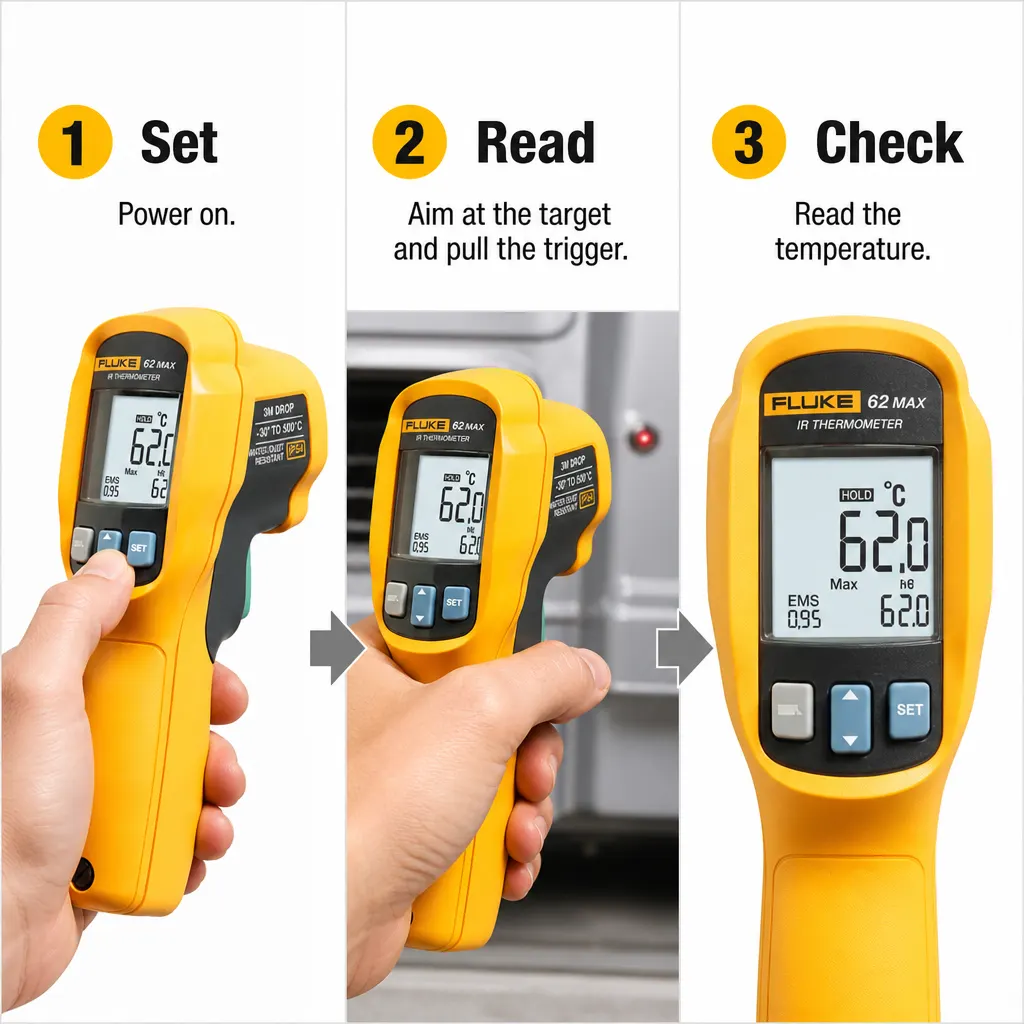
Set the electrical safety boundary before selecting a method
HSE says work on electrical equipment must be planned, energy sources securely isolated where work is carried out, and the people involved competent for the task. HSG85 says work on or near exposed live conductors should rarely be permitted and dead working is essential unless all three legal conditions for live work are met. This guide does not replace those rules or authorise live work.
A non-contact instrument does not remove electric-shock, arc or access hazards. The employer's risk assessment and safe system of work must define any permitted observation; this article provides no procedure for opening a panel, defeating an interlock or approaching exposed live parts.
- Do not use this article as a live-panel method statement.
- Do not remove covers, defeat interlocks or approach exposed live parts for a reading.
- Do not continue if the employer's risk assessment and safe system of work do not authorise the observation.
- Refer concerns to the responsible competent person without changing the panel state.
Account for emissivity and the complete measurement spot
Panel surfaces may include paint, labels, plastic windows and bare or polished metal. These materials do not emit infrared energy in the same way. Fluke specifically warns that reflective objects can indicate less than their actual temperature. A comparison across unlike finishes is therefore weak evidence unless the procedure controls the surface and emissivity.
Fluke specifies a 10:1 ratio for the 62 MAX, calculated at 90% energy. The manual's diagram shows a 100 mm spot at 900 mm, so a small target could be mixed with its surroundings. The single laser marks aim rather than the spot boundary; use the official spot diagram rather than an informal distance calculation.
| Source of uncertainty | Effect on interpretation | Control |
|---|---|---|
| Shiny or reflective metal | May read below actual temperature | Follow the exact manual and approved site method |
| Spot larger than target | Includes neighbouring surfaces | Use verified optical data and a target larger than the spot |
| Different surface finishes | Weakens direct comparison | Compare like with like or document the limitation |
| Concealed components | Surface value may not represent them | Do not infer internal temperature |
Confirm the instrument and preserve an auditable record
The retailer identifies an AA-powered Fluke 62 MAX but says IP40. Fluke's official product page, user manual and data sheet specify IP54, a 10:1 ratio and emissivity adjustment from 0.10 to 1.00 for the 62 MAX. Treat IP40 as an unresolved retailer listing discrepancy and ask for clarification rather than inventing a separate promotional specification.
Under the stated calibration geometry with ambient temperature at 23 °C ±2 °C, Fluke specifies a -30 °C to 500 °C range and, at or above 0 °C, accuracy of ±1.5 °C or ±1.5% of reading, whichever is greater; wider limits apply below 0 °C. These figures describe instrument performance under stated conditions, not the uncertainty of inferring a concealed component's temperature from an enclosure surface.
- Record the full product identity and manual revision.
- Do not treat the retailer's conflicting IP40 wording as verified; ask it to resolve the discrepancy.
- Keep readings as observations within the maintenance record.
- Escalate anomalies; never translate them directly into a fault diagnosis.
Related guides and product details
Use a non-contact thermometer on panel exteriors only where the competent person and site procedure permit it, and choose the exact unit on documented optical and emissivity evidence. Read Non-Contact Thermometer for Workshop Surface Checks for related guidance. Read Infrared Thermometer for Electricians: UK Buying Guide for related guidance. Review the documented specification on the Fluke 62 MAX handheld infrared thermometer product page before ordering.
Sources and safety context
- Supports the retailer's 62 MAX offer identity, AA power and surface-reading description; its IP40 wording conflicts with Fluke. Fluke 62 MAX handheld infrared thermometer details.
- Supports surface-temperature scope, emissivity range and reflective-object warnings. 62 MAX/62 MAX+ Infrared Thermometer Users Manual.
- Supports the standard 62 MAX 10:1 optical ratio, 0.10 to 1.00 emissivity range and IP54 specification. 64 MAX, 62 MAX+ and 62 MAX IR Thermometers Data Sheet.
- Supports planning, isolation and competence requirements. Work on electrical equipment, machinery or installations.
- Supports avoiding live working where possible and using risk-assessed, task-specific safe procedures. Electricity at work: Safe working practices.